1/ Women’s Small Leather Goods: The Main Formats and How to Use Them
Women’s small leather goods stand apart from their men’s equivalents through a greater diversity of formats and more varied uses. Here are the main families of pieces and what each one offers in practice.
The long wallet
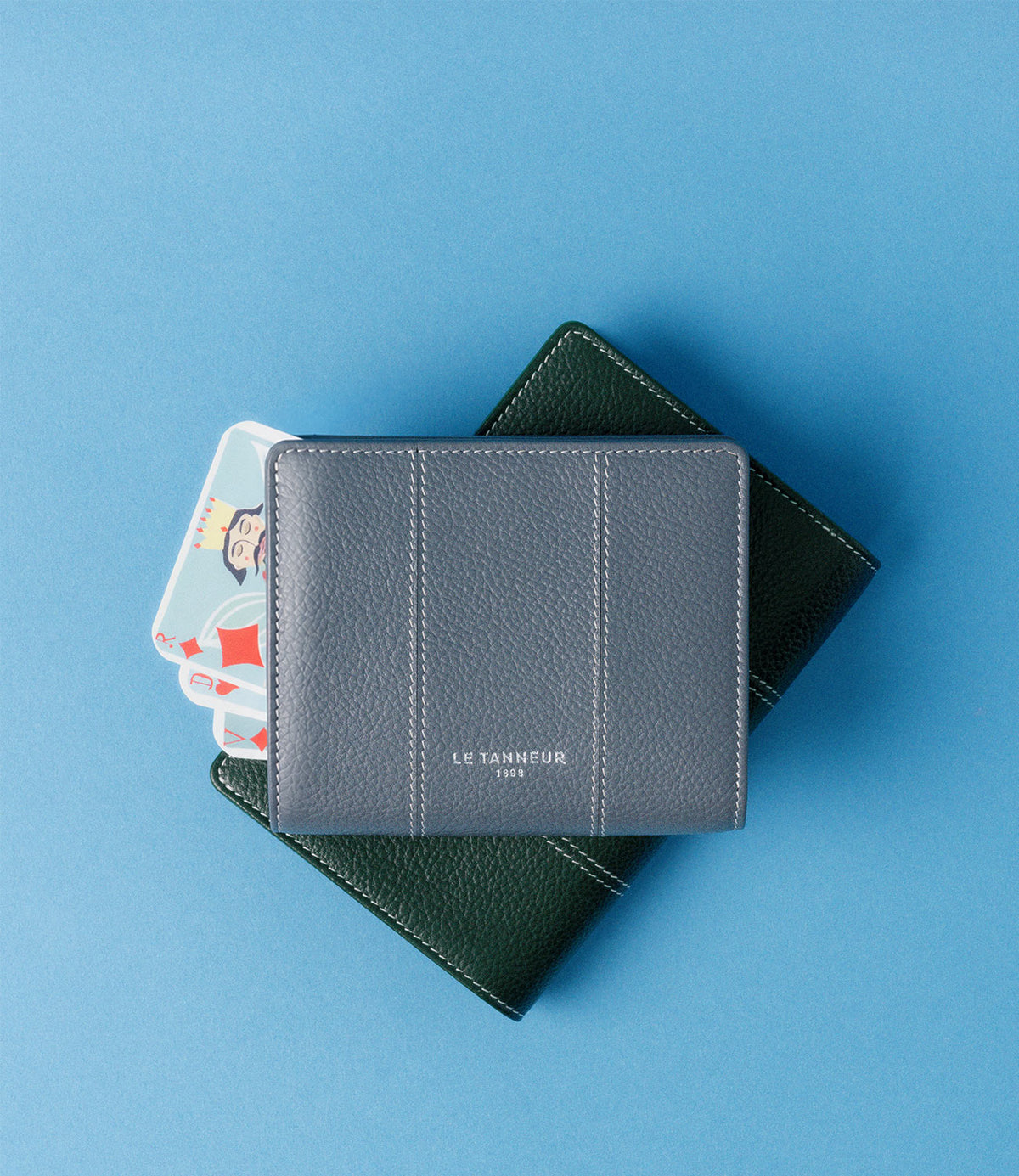
The long wallet, zipped or with a flap, is the most complete format in women’s small leather goods. It generally measures between 19 and 20 cm long and 10 cm high. It features numerous card slots, a generous notes compartment, a zipped coin pocket and sometimes an ID window. It is the format favoured by women who want to keep all their documents in a single piece and who carry a medium or large bag. At Le Tanneur, the Louison line offers this format in grained and smooth leather, with up to 10 card slots.
The compact wallet
Smaller than the long wallet, the compact flap wallet measures between 11 and 14 cm long. It offers an intermediate capacity: several card slots, a notes pocket and a coin pocket. It is the best compromise between capacity and size, and fits most bags, including medium formats. The Louison line comes in this format in grained and smooth leather, in several versions with 5 to 9 card slots.
The card holder
The women’s card holder meets the need for simplicity that comes with compact bags and mini-bags. Slim and light, it slips into the smallest bags without taking up space. Models range from the simple 4-slot card holder to the 6-slot flap card holder, with or without a built-in coin pocket. The Louison line offers this format in grained and smooth leather, in a wide range of colours.
The coin purse
Long considered a secondary accessory, the coin purse is back in favour as a standalone piece. It is carried on its own or alongside a card holder, especially by women who like to keep their cash separate from their cards. Formats range from the compact zipped coin purse to the box coin purse with a notes pocket. The Albertine line in grained and smooth leather covers all of these formats, with zipped models from 11.5 × 9 cm to 12 × 9 cm.
The organised pouch
Halfway between a wallet and a clutch, the organised pouch is a hybrid format for women who want to carry more without carrying a bag. It features numerous card slots, a zipped pocket and sometimes a detachable shoulder strap. The Paulette line offers this format in smooth leather, with 8 card slots and an interior flat pocket, measuring 19 × 13 × 4 cm.
The envelope set
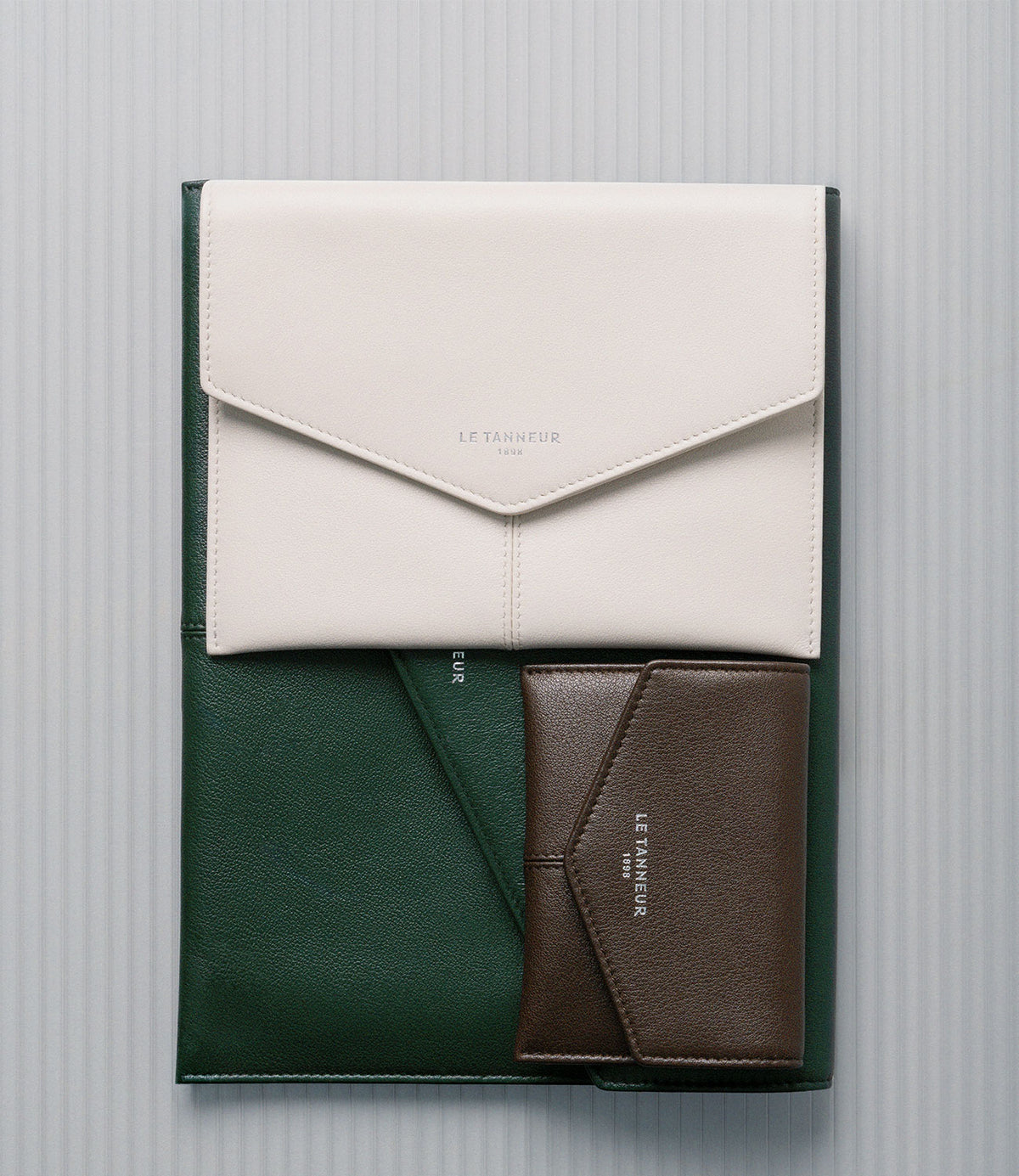
A more original format, the envelope set is a flexible way to organise cards, documents and small items across several pouches of different sizes. The Paulette line offers a set of three smooth leather envelopes in three complementary sizes: small (10 × 7 cm), medium (15.5 × 11.5 cm) and large (23 × 16.5 cm).
Organisation interne : le critère décisif
Pour la petite maroquinerie féminine, l'organisation interne est le critère numéro un. Un portefeuille joli mais vide est une frustration quotidienne. Fentes cartes, compartiment billets, poche zippée monnaie, fenêtre identité : chaque élément a son rôle. Un "joli vide" ne suffit pas, aussi beau soit-il.
Le nombre de fentes cartes
La vraie question n'est pas combien de cartes votre portefeuille peut contenir, mais combien de cartes vous utilisez réellement. La plupart des femmes utilisent entre 6 et 10 cartes au quotidien : une ou deux cartes bancaires, carte d'identité, carte vitale, cartes de fidélité, parfois une carte de transport. Un portefeuille long à 10 compartiments couvre tous les besoins ; un portefeuille compact à 6 fentes suffit à celles qui ont simplifié leur usage.
Le compartiment billets
Le compartiment billets est une question dimensionnelle. Un portefeuille long accueille les billets à plat, sans les plier. Un portefeuille compact peut nécessiter de les plier en deux. Si vous préférez conserver vos billets à plat, choisissez un format d'au moins 16 cm de longueur.
La poche monnaie zippée
La poche monnaie zippée est souvent ce qui distingue un portefeuille d'un porte-cartes. Pour celles qui manipulent encore régulièrement des espèces, elle est non négociable. Pour celles qui sont passées entièrement aux cartes, un porte-cartes sans poche monnaie suffit. Un détail sur le son : une poche monnaie zippée bien construite, avec un métal de qualité, s'ouvre et se ferme silencieusement ; une pièce de mauvaise qualité devient vite une signature sonore gênante.
La fenêtre identité
La fenêtre identité transparente permet de montrer un document d'identité ou une carte sans la sortir, ce qui est pratique à un guichet ou en embarquement. La ligne Louison l'intègre sur le portefeuille long.
2/ Women’s Small Leather Goods: Finding the Right Fit for Your Bag
It is one of the most specific questions in small leather goods, and one of the least well documented. The format of a wallet or card holder cannot be judged independently of the bag it will be carried in. A long wallet that suits a tote perfectly becomes unusable in a mini-bag.
Mini-bag and micro-bag: the card holder reigns
Mini-bags and micro-bags impose strict size constraints. With an interior width rarely over 15 cm and limited depth, they leave room only for the most compact formats. The simple 4-slot card holder (10 × 7.5 cm) and the 4-slot flap card holder (10.5 × 7.5 cm) from the Louison line are the formats best suited to these bags. A compact zipped coin purse from the Albertine line (11.5 × 9 cm) can complete them if space allows.
Crossbody and baguette bag: the compact wallet
Crossbody and baguette bags offer slightly more interior space but remain narrow. With a length of 11 to 14 cm, the compact flap wallet is the reference format for these bags. The Louison 5-slot and 9-slot notes wallets (11 × 10 cm to 14 × 10 cm) slip in with ease. Avoid long formats over 19 cm, which pull the bag out of shape or stop it closing properly.
Tote bag and shopper: every format works
Tote bags and shoppers offer generous interior space that takes every small leather goods format. This is where the Louison long zipped wallet (19 × 10 cm) comes into its own, with its 10 card slots and zipped coin pocket. The Paulette organised pouch (19 × 13 × 4 cm) also finds its natural place here, structuring the inside of the bag and keeping things from getting lost.
How to measure before you buy
The most reliable way to check whether a wallet will fit your bag is simple: measure the width and depth of your bag’s main compartment and compare them with the dimensions of the wallet you have in mind. Allow a margin of 2 to 3 cm so the wallet slides in and out without forcing. A small leather good that fits too tightly in a bag will eventually deform both.
The three-dimension rule
Width, height and thickness: all three need checking. A wallet may fit a bag in width and height but still be too thick for the interior zipped pocket. A card holder may look compact but stick out above a small pouch. Checking all three dimensions before buying avoids unpleasant surprises.
Matching colours between your bag and small leather goods
Colour is often treated as a minor detail. Yet it deserves real attention, especially when the small leather good is visible as you open your bag or is carried on its own. Two approaches stand apart: coordination and contrast. Coordination means choosing a small leather good in the same colour as the bag, or in a close shade. It is the most classic approach, creating a consistent, polished look. Contrast plays on difference instead: a Malachite wallet in a Black bag, an Arabica card holder in a Fossile bag. This approach adds character and personality to the whole look. Our seasonal palettes are designed to make these pairings easy: seasonal colours sit naturally alongside the timeless Black, Tan and Fossile, giving you plenty of freedom to mix and match without ever striking a wrong note.
3/ Small Leather Goods: Leather Chosen for Quality, Feel and Durability
Leather is the core material of any small leather good. It determines how long the piece lasts, how it behaves in use and how it ages over time. In women’s small leather goods, the choice of leather is also a matter of aesthetics and the senses: how a wallet feels and how it responds in the hand are very much part of the experience.
Smooth or grained leather: two distinct characters
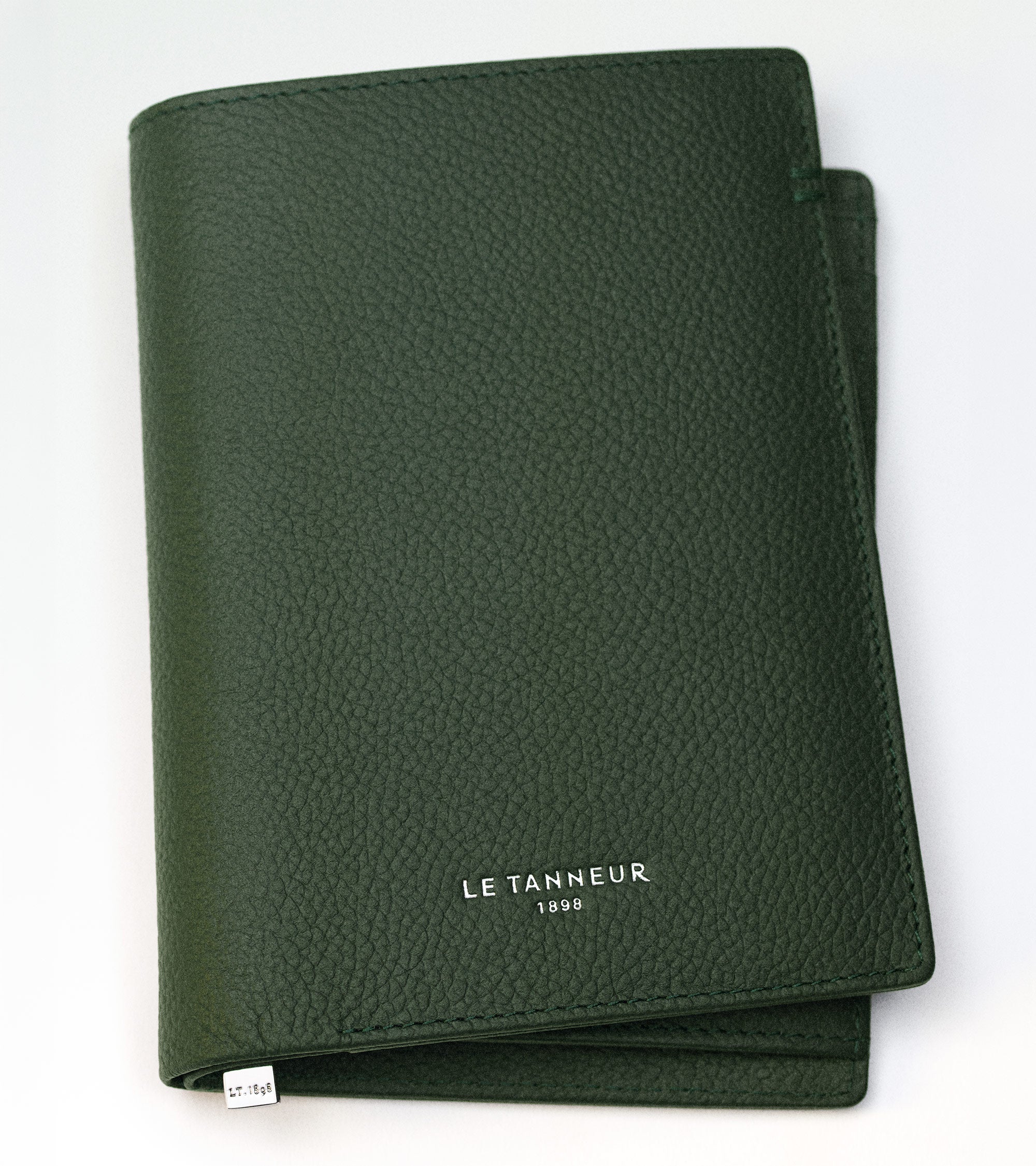
Smooth leather and grained leather are both full-grain leathers of equal quality. The difference lies in the surface treatment. Smooth leather keeps the natural surface of the hide, untouched: it feels soft and clean to the touch, with an elegant, understated look. Over time it develops a more visible, more pronounced patina that gradually reveals the story of the piece. It is the leather of choice for women who want a living object that evolves with use.
Grained leather has been heat-pressed to accentuate or create a regular grain on the surface. Slightly less prone to scratches and everyday marks, it is more versatile and easier to care for day to day. It is the natural choice for a piece that sees heavy use and is regularly slipped in and out of a bag.
Light colours: how does leather age?
Light colours such as Fossile and Tan often raise the question of ageing. A quality full-grain leather in a light colour does not yellow: it develops a patina, meaning slightly deeper nuances appear in areas of friction, reinforcing its character without changing the base colour. Regular nourishing with a suitable cream protects the surface and slows this natural maturing process. A low-quality leather in a light colour, on the other hand, will yellow, stain and lose its original look without ever developing a harmonious patina.
The Louison line: grained and smooth leather
Le Tanneur’s Louison line illustrates this duality between grained and smooth leather. The grained full-grain leather models, available in Black, Tan, Fossile, Steel Blue and Révolution, offer greater resistance to everyday use. The smooth full-grain leather models, in Black, Tan, Arabica and Malachite, focus on a soft feel and an elegant surface. In both cases, the leather is full-grain cowhide, selected for its consistency and its ability to develop a beautiful patina over time.
Certifications and traceability
The quality of a leather cannot always be judged with the naked eye. Certifications are a reliable indicator of how demanding a house is about sourcing its materials. LWG (Leather Working Group) certification guarantees that the leather comes from tanneries whose environmental practices have been audited and approved. It covers the management of water, waste and the chemicals used in the tanning process. It is a criterion more and more women look for when they care about the environmental impact of what they buy.
4/ Craftsmanship and Know-How: What Sets a Well-Made Women’s Small Leather Good Apart
The quality of a women’s small leather good is not just about the leather, the design or the finishing. The way it is constructed matters just as much for how long it lasts. A well-made piece withstands heavy use, keeps its shape and finish over time, and can be cared for or repaired by a leather craftsman.
The making process
Making a small leather good starts with selecting and cutting the hides. Each piece is cut to the exact shape of the pattern, taking into account the direction of the grain and future stress points. Skiving comes next: the edges of the leather are thinned at the joins to avoid unsightly bulk and keep the piece slim in the hand. It is a step you cannot see, but it is decisive for the comfort and elegance of the finished object.
Assembly follows: the different pieces are stitched together in a precise order that determines the strength of the whole. The edges, dyed and polished by hand, complete the process. On a well-made piece, the edges are smooth, even and hard-wearing. On a poorly made piece, they quickly crumble and betray a lack of care in the finishing.
Saddle stitch
Saddle stitching is the benchmark for leather sewing. Done by hand with two needles and waxed thread, it is stronger than machine stitching: if one stitch breaks, the seam does not come undone and can be repaired by a craftsman. At Le Tanneur, founded in 1898, the art of saddle stitching has been passed down for more than 125 years and is one of the hallmarks of the house.
Interior finishing
The inside of a women’s small leather good is as revealing as its exterior. A quality textile lining, well-sized card slots, cleanly finished inner edges: these are the details that separate a piece built to last from one built just to look good. At Le Tanneur, women’s small leather goods have a 100% textile lining in Crépuscule across the Louison, Albertine and Marguerite lines, and a 100% polyester lining in Crépuscule on the Paulette line. A carefully finished interior shows attention paid to the whole piece, including the places the eye does not go first.
Metal hardware
Zips, press studs, rings: these components face intensive wear on a small leather good used every day. Quality metal, properly fixed and resistant to oxidation, does not loosen or tarnish prematurely. Metal finishes on Le Tanneur pieces come in silver or light gold depending on the line and colour, with consistent finishing guaranteed across each piece.
5/ Card Holder or Wallet for Women: How to Decide?
This is the most common dilemma in women’s small leather goods. Switch to a card holder or keep a classic wallet? The answer depends on a few concrete criteria, worth assessing honestly before you choose.
- How many cards do you really use?
This is the starting point. List the cards you actually take out day to day, not the ones you carry just in case. In practice, few women use more than six to eight cards regularly: one or two bank cards, a driving licence or ID card, a travel card and one or two loyalty cards. If that number does not exceed eight, a card holder with a built-in notes pocket is more than enough. Beyond that, a compact wallet is the better fit.
This is the second deciding factor. If you still pay in cash regularly, a wallet with a notes compartment and a zipped coin pocket remains essential. If your cash is limited to the occasional few coins, a standalone coin purse from the Albertine line paired with a Louison card holder is a more elegant and more practical alternative: two specialised pieces rather than a single catch-all.
- What type of bag do you carry every day?
The format of your bag often dictates the format of your small leather goods. A mini-bag or a compact baguette bag leaves room only for a slim card holder. A shopper or tote bag takes every format, including a long zipped wallet. If you switch between several types of bag depending on the occasion, a compact card holder remains the most versatile format: it adapts to every bag, whereas a long wallet is ruled out of the smallest ones.
- How do you like to organise your things?
Some women need to keep everything in one place: cards, notes, coins and sometimes documents. For them, the Louison long zipped wallet, with its 10 card slots and zipped coin pocket, is the most complete answer. Others prefer to split things up: a card holder for cards, a coin purse for cash and an organised pouch for documents. This multi-piece approach is often more efficient day to day, provided the bag is large enough to hold them all.
- The card holder as your main piece
Switching to a card holder does not mean giving up quality or elegance. A well-made, well-cared-for full-grain leather card holder is a piece in its own right, deserving as much attention as a wallet. Le Tanneur’s Louison line offers flap card holders in grained and smooth leather, with 4 or 6 card slots, in a wide range of colours. Pieces designed to last and to be carried with as much care as a bag.
6/ How to Choose Women’s Small Leather Goods That Last
The colour and finishes of a small leather good are not just aesthetic choices. They are also criteria for durability. Some colours age better than others. Some finishes stand up better to life in a bag. All of these factors are worth considering when choosing a piece made to last.
Deep, saturated colours such as Black, Malachite and Steel Blue are the most resistant to visible ageing. They hide small everyday marks better and develop a subtle patina that reinforces their character without changing their overall look. Mid-tones such as Tan, Arabica and Fossile age harmoniously on a quality full-grain leather: their natural patina deepens gradually, creating rich, living nuances. Very light colours such as Chalk, Fleur de Sel and Greige are the most delicate to care for. They show handling marks more readily and need more regular care to keep their brightness. On these colours, frequent nourishing and waterproofing from first use are essential.
- Metal finishes: silver or gold?
The choice between a silver and a gold finish is above all a question of style and of coordination with the other accessories you wear. In terms of durability, both finishes are equal, provided the metal is of good quality and properly fixed. A finish that tarnishes quickly or flakes off betrays poor-quality metal. At Le Tanneur, metal finishes are consistent across each piece: silver on deep colours such as Black, Steel Blue and Malachite, light gold on warm colours such as Tan and Arabica.
- Fastenings: a stress point to watch
Clasps, press studs and zips are the most heavily used parts of a small leather good. A quality press stud fastens and releases with a firm, even resistance, without forcing and without loosening over time. A quality zip glides without catching and withstands intensive use without jamming or warping. These components are often the first to reveal the overall quality of a piece: a faulty fastening on a new piece is a warning sign not to ignore.
- The interior lining: an often-overlooked criterion
The interior lining of a small leather good contributes directly to its durability. A quality textile interior withstands the repeated friction of cards and notes without tearing or coming unstuck. A sloppy interior, with raw fabric edges or lining that peels away at the corners, reveals poor construction. At Le Tanneur, women’s small leather goods in the Louison, Albertine and Marguerite lines have a 100% polyester lining in Crépuscule: lines designed to withstand intensive use while adding an aesthetic touch on the inside.
- Durability as a responsible buying criterion
Choosing a durable small leather good is also an eco-conscious choice. A well-made full-grain leather piece, bought once and used for ten to twenty years, has a far smaller environmental impact than several low-quality pieces replaced regularly. It is one of the deep convictions that has guided Le Tanneur since 1898: making objects designed to last, by selecting quality materials and applying craftsmanship passed down from generation to generation.
7/ How to Spot a Well-Made Women’s Small Leather Good
A quality small leather good can be recognised by precise details you can see or feel. Here is a checklist of concrete criteria to assess a piece before you buy it.
Card slot ergonomics
Card slots should hold cards firmly without squeezing them. A card that will not come out without effort eventually damages both the leather and the card. A card that slips and falls out reveals poorly sized slots. The right depth lets you take a card out smoothly with one hand, without searching or forcing. An ergonomics problem often hides a quality problem, and therefore a less durable product.
The edges
The edges are the visible borders of the leather around the whole piece. On a well-made piece, they are dyed to match the leather, polished by hand and smooth to the touch along their entire length. Roughly painted, uneven or raw edges are a sign of mass production with no attention to finishing. They are one of the first places to look when assessing the quality of a piece.
The stitching
Quality stitching is even and taut, with no skipped stitches or loose threads. Saddle stitching can be recognised by its perfect regularity and the absence of visible stress points. On a small piece such as a card holder or coin purse, the stitching is often the only visible element of construction: it must be flawless.
Thickness at the joins
The joins between two pieces of leather, especially at the corners and gussets, should be thin and even. Careful skiving ensures a consistent thickness with no unsightly bulk. A thick, uneven join betrays insufficient or absent skiving, and signals premature wear at the stress points.
The interior lining
The inside of a small leather good is as revealing as its exterior. A quality textile lining, well-sized card slots, cleanly finished inner edges: these are the details that distinguish a piece built to last. A sloppy interior, with raw fabric edges or misaligned slots, reveals a lack of attention to the construction as a whole.
Metal hardware
Zips, press studs, rings: these components must be securely fixed, resistant to oxidation and smooth to use. A zip that catches from the first few uses, a press stud that loosens or a ring that quickly tarnishes are warning signs about the overall quality of the piece.
The feel of the leather
A quality full-grain leather feels clean to the touch, slightly supple, with a gentle natural resistance. It does not stick to the fingers, does not smell of plastic and does not have an overly uniform surface. Bonded or low-quality leather can often be recognised by a feel that is too stiff, too smooth or slightly sticky.
Consistency of finishing
On a well-made piece, every finish is consistent: the colour of the edges matches the leather, the stitching thread is coordinated and the metal hardware has a uniform finish across the whole piece. Any inconsistency in the finishing, however small, betrays a lack of quality control at the end of production.
8/ Caring for Women’s Small Leather Goods: The Right Habits to Make Them Last
A well-cared-for full-grain leather small leather good can last ten to twenty years, sometimes longer. Care is not a chore: it is what allows the material to develop its character and age with elegance. Women’s small leather goods are carried in a bag, handled several times a day and exposed to whatever lies at the bottom of it, so they call for a few specific habits.
How women’s small leather goods wear
A small leather good carried in a bag faces specific wear. Repeated friction against the sides of the bag and the other things inside it gradually wears down the corners and edges. Pens, keys and cosmetics sharing the bottom of a bag can stain or scratch the leather surface. Residual moisture, sometimes present at the bottom of a bag used in all weathers, can damage unprotected leather. All of these factors are worth anticipating when adapting care and storage.
Cleaning
Regular cleaning with a soft, dry cloth removes dust and everyday residue. For light marks, a slightly damp cloth is enough on both grained and smooth leather. Always avoid solvent-based products, which dry out and permanently damage the leather surface. On smooth leather, deal with stains quickly: the longer a stain dries, the harder it is to remove without leaving a mark.
Nourishing
Applying a nourishing leather cream two to three times a year hydrates the material and prevents drying and cracking. Le Tanneur offers a renovating leather care (ref. TZ1PH5599, 75 ml) formulated to nourish, waterproof and soften leather. Apply a small amount with a cotton cloth in circular movements, let it absorb, then wipe away any excess. On light colours, test the product on a discreet area first.
Protection
A new smooth leather piece benefits from being waterproofed from first use. This preventive step protects the leather surface against moisture and stains, without altering its appearance or natural breathability. It is particularly recommended for light colours, which show handling marks more easily. Repeat two to three times a year depending on how often you use it.
Storage
When the piece is not in use, avoid leaving it crushed under other objects or in a position that distorts the leather. Keep it away from direct heat and prolonged sunlight, which dry out and fade leather prematurely. Storing it in its original dust bag or box, protected from dust, is ideal when you are not using it. At Le Tanneur, every small leather good comes in its own individual box, designed to protect the piece between uses.
Warning signs
Leather that starts to crack needs nourishing. Crumbling edges signal insufficient edge finishing or poor-quality leather. Stitching that gives way at a single point can be repaired by a leather craftsman before the problem spreads. A well-made full-grain leather piece can be repaired: it is one of the major advantages of investing in quality rather than regularly replacing cheap pieces.